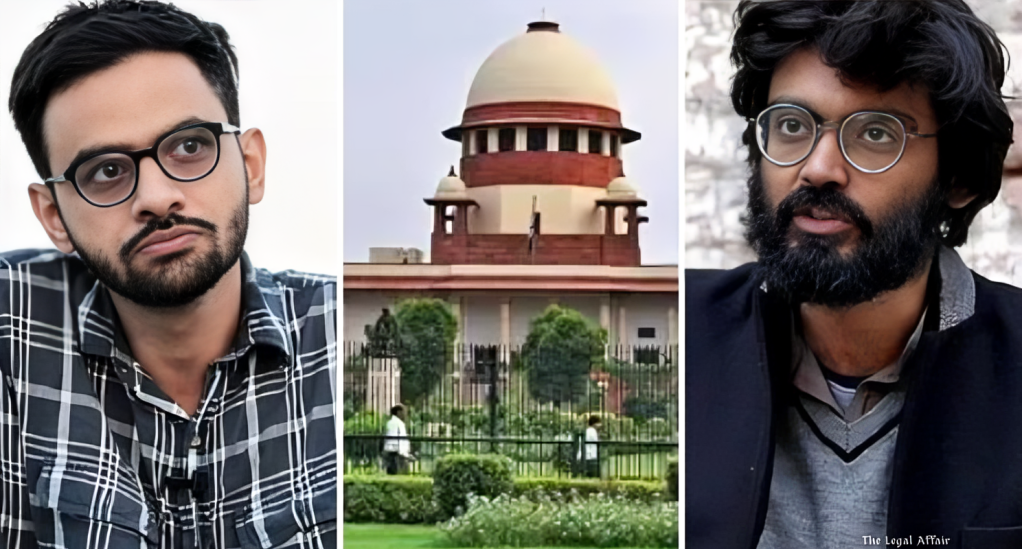


DIVYA DELHI : The Supreme Court’s recent refusal to grant bail to activists Umar Khalid and Sharjeel Imam in cases related to the Delhi riots has triggered renewed debate over the interpretation of the Unlawful Activities (Prevention) Act (UAPA) and concerns about judicial consistency and independence. At the centre of the controversy is the Court’s interpretation of Section 15 of the UAPA, which defines what constitutes a “terrorist act.” Critics argue that the provision has been applied in a manner that departs from both statutory intent and established judicial precedent, particularly in cases where trials have faced prolonged delays. Legal observers have pointed out that a fundamental question remains unanswered: what specific terrorist act have the accused committed under the UAPA? The contention is that if no such act exists within the meaning of the law, the continued denial of bail raises serious constitutional concerns. A bench comprising Justices Aravind Kumar and N.V. Anjaria delivered the judgment, which has been criticised for broadening the scope of Section 15. The provision requires not only an intent to threaten the unity, integrity or sovereignty of India, but also the use of terror-inducing means such as explosives, firearms or other methods likely to cause mass harm or disruption of essential services. Legal experts argue that the statutory framework ties terrorism to extraordinary violence and terror-producing methods, not to ordinary criminal acts or political dissent. However, in high-profile cases such as the Bhima Koregaon case and the Delhi riots case, no overt acts involving explosives, firearms or similar terror-linked means have been attributed to the accused. In the Bhima Koregaon case, several accused persons remained incarcerated for over five years without trial, while advocate Surendra Gadling has spent nearly seven years in prison without bail. Bail in some cases was granted only after prolonged detention, raising questions about adherence to precedents concerning delay in trial. Both cases primarily rely on electronic evidence. In the Bhima Koregaon matter, forensic investigations later indicated that certain digital files may have been remotely planted, casting doubts on the prosecution’s narrative. Additionally, no direct link was established between the accused and the violence that occurred more than 24 hours after the Elgar Parishad event on December 30, 2017. Critics argue that the repeated invocation of UAPA in such cases, despite the absence of violence or terror-linked acts, risks diluting the distinction between terrorism and dissent. They warn that continued denial of bail under stringent anti-terror laws, even in the absence of trials, undermines the principle of personal liberty and the constitutional guarantee of due process. The debate has once again brought judicial scrutiny of anti-terror legislation into focus, with calls for clearer standards, stricter adherence to precedent, and safeguards against prolonged pre-trial incarceration.